Head Start and children with disabilities: the 10% rule, and how to ask for an evaluation
Federal law requires at least 10 percent of the children a Head Start program enrolls to have disabilities. What that means, and how to request an evaluation.
At least 10 percent of the children a Head Start program actually enrolls must be children with disabilities who are eligible for special education and related services, or for early intervention services, under the Individuals with Disabilities Education Act. That requirement is in section 640(d) of the Head Start Act, applies to every Head Start agency and delegate agency, and has been in force since fiscal year 2009. The regulation that implements it puts the number on each program: at least 10 percent of a program’s total actual enrollment must be filled by children eligible for services under IDEA, unless the responsible federal official grants a waiver. It is a floor on enrollment, not a quota that limits how many children with disabilities a program may serve.
Two other rules matter just as much to a parent. A program may not deny enrollment because of a disability or a chronic health condition, or because of how severe it is. And a child who enrolls with a disability must receive all applicable program services in the least restrictive possible environment — meaning the disability changes what the program must provide, not whether it must provide it.
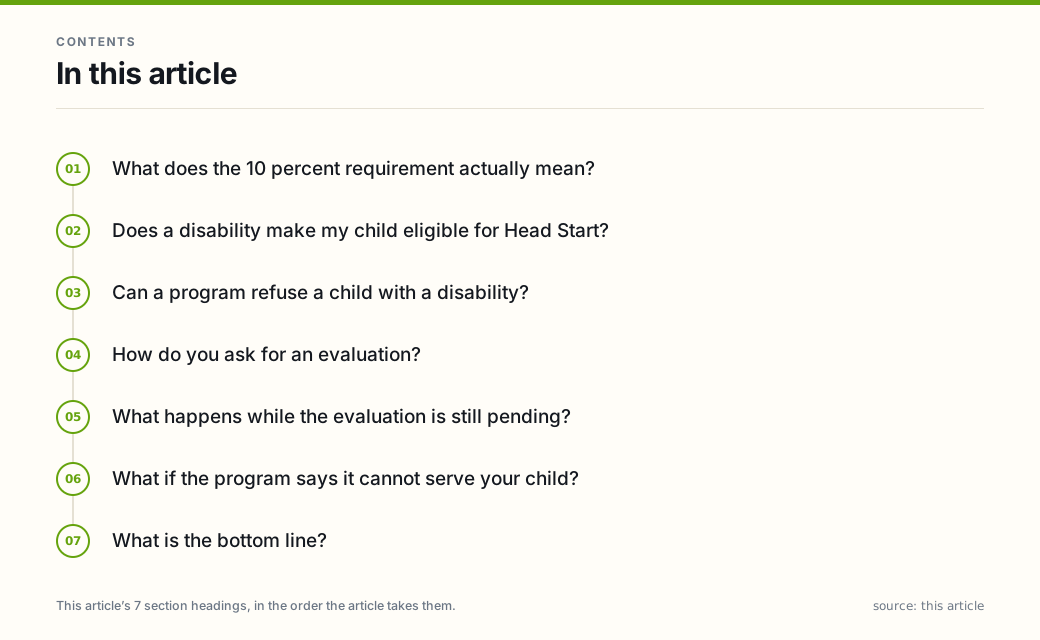
What does the 10 percent requirement actually mean?
The statutory language is specific: “not less than 10 percent of the total number of children actually enrolled by each Head Start agency and each delegate agency will be children with disabilities who are determined to be eligible for special education and related services, or early intervention services, as appropriate, as determined under” IDEA. Three details in that sentence are worth reading twice.
- “Actually enrolled” — the denominator is children in seats, not funded slots and not applications.
- “Each agency and each delegate agency” — a large grantee cannot average a strong program against a weak one; the test applies to each entity.
- “Eligible under IDEA” — the disability has to be one that makes the child eligible for special education, related services or early intervention, as determined by the agency that runs IDEA in your area. A diagnosis alone is not the trigger.
Does a disability make my child eligible for Head Start?
Not by itself, and this is where families most often get a wrong answer in both directions.
Eligibility still turns on the income tests in 45 CFR 1302.12: household income at or below the federal poverty line, or a family that is eligible for public assistance, homeless, or with a child in foster care. Disability is not one of those routes.
What the disability does is change a child’s priority. Under 45 CFR 1302.14(a), a program must weigh family income, homelessness, foster care, the child’s age, and whether the child is eligible for special education or early intervention services under IDEA, along with other family or child risk factors. Under 1302.14(b), once the 10 percent requirement is met, children eligible for services under IDEA should be prioritized for available slots under the program’s own selection criteria. A child who is eligible for services under IDEA is a factor a program is required to consider, not a separate door into the program.
There is one bridge between the two. A program may fill up to 10 percent of its enrollment with children who would benefit from services but do not meet an income test (45 CFR 1302.12(c)(2)), and it may use part of that allowance for a child with a disability. Ask the program whether it does.
Can a program refuse a child with a disability?
No. The performance standards state plainly that a program “must not deny enrollment based on a disability or chronic health condition or its severity”. That sits alongside a service obligation: children with disabilities must be able to participate fully in all program activities, and the program must make the modifications the child needs — changes to the environment, varied formats for instruction, individualized accommodations and supports.
The legal backstop is broader than Head Start. Programs must also comply with section 504 of the Rehabilitation Act and with the Americans with Disabilities Act, which apply to the grant recipient as an entity receiving federal money and as a place of public accommodation.
How do you ask for an evaluation?
The route depends on the child’s age, and in both cases the request can come from a parent.
Under three: Part C early intervention. Every state runs an early intervention program under Part C of IDEA for infants and toddlers with disabilities or developmental delays. A parent, a doctor, a child care provider or a hospital can make the referral. The state decides whether the child is eligible, and if so writes an Individualized Family Service Plan (IFSP) that sets out the services.
Three and older: the local school district. Under Part B of IDEA, the district is responsible for “child find” — identifying, locating and evaluating all children with disabilities in its jurisdiction who need special education and related services, regardless of the severity of the disability and including children who are homeless or attending private school. A parent may request an initial evaluation directly. Once a parent consents, the evaluation must be completed within 60 days, unless the state has established its own timeframe, in which case that one applies.
Put the request in writing, date it, and keep a copy. A written request creates a record that a phone call does not, and the 60-day clock under 34 CFR 300.301(c) runs from parental consent, not from the day you first asked.
What happens while the evaluation is still pending?
The program cannot use a pending evaluation as a reason to do nothing. Under 45 CFR 1302.61(b), while the local IDEA agency decides whether the child is eligible, a Head Start program must provide individualized services and supports to the maximum extent possible, based on what it already knows — parent input, observation, assessment data — and may spend program funds on them. Some supports may be available through the family’s health insurance; where they are not, the program must individualize its services with what it has and may use program funds to do so.
Once an IFSP or IEP exists, the program must work with the IDEA agency, the family and other service partners to make sure the services in the plan are planned and delivered, and must keep the child in the least restrictive setting that works.
What if the program says it cannot serve your child?
Ask for the refusal in writing, with the reason. A statement that a child cannot be served “because of the disability” conflicts with 45 CFR 1302.14(a)(5) on its face. If the answer is instead that the program lacks the capacity to meet a particular need, ask which need, and in writing.
Three escalation routes are worth knowing:
- The program’s own management. A grant recipient has a governing body, and where the rules require one, a policy council that includes parents; both have a formal role in program decisions.
- The federal office that funds the grant. The Office of Head Start administers Head Start grants through regional offices, and the program’s federal funding carries the obligations above.
- The IDEA agency. If the child is eligible for services under IDEA, the school district or early intervention program owes the services in the IEP or IFSP independently of what Head Start does. A dispute about those services has its own procedural protections, including mediation and due process.
What is the bottom line?
Head Start programs must enroll children with disabilities at a rate of at least 10 percent of actual enrollment, may not refuse a child because of a disability, and must provide the accommodations that let the child take part in everything the program offers. Eligibility for a place is still decided on income or on public assistance, homelessness or foster care — but a disability raises a child’s priority in selection and can be the reason a program uses its over-income allowance.
The step most families can take this week is a written evaluation request: to the state early intervention program if the child is under three, or to the local school district if the child is three or older. If you are still choosing a program, our guide to who qualifies for Head Start and how to apply covers the income tests and the documents intake staff will ask for; if you are weighing a program’s staffing changes, what changed in the 2026 wage rule explains which obligations remain.
Frequently asked questions
- Can a Head Start program reject my child because of a disability?
- No. The performance standards say a program must not deny enrollment based on a disability or chronic health condition, or on the severity of either. Once enrolled, a child with a disability must receive all applicable program services in the least restrictive possible environment and must be able to take part in all program activities.
- What is Head Start's 10 percent rule?
- Section 640(d) of the Head Start Act requires the Secretary to ensure that, for fiscal year 2009 and afterward, not less than 10 percent of the total number of children actually enrolled by each Head Start agency and each delegate agency are children with disabilities who are eligible for special education and related services, or for early intervention services, under the Individuals with Disabilities Education Act. The implementing regulation adds one caveat: the responsible federal official can grant a waiver. It is a floor on enrollment, not a cap.
- Does having a disability make my child eligible for Head Start?
- Not by itself. Eligibility still turns on income at or below the poverty line, or on public assistance, homelessness or foster care. A disability is a selection factor — programs must weigh whether a child is eligible for special education or early intervention services when ranking applicants — and a program may use its small over-income allowance to enroll a child who would benefit. Ask the program how it applies both.
- How do I get my child evaluated for early intervention or special education?
- Under three, ask your state's early intervention program, which operates under Part C of the Individuals with Disabilities Education Act; a doctor, a child care provider or a parent can make the referral. At three and older, ask the local public school district in writing for an initial evaluation under Part B. Federal rules let a parent request that evaluation, and it must be completed within 60 days of parental consent unless the state has set its own timeline.
- What happens if my child starts Head Start before the evaluation is finished?
- The program cannot wait for the paperwork. While the local agency decides whether a child is eligible under IDEA, the program must provide individualized services and supports to the maximum extent possible, based on information such as parent input and observations, and may use program funds to do it.
Sources
Each source is a primary or official reference, checked before publication. Links open the original.
- 42 U.S.C. 9835(d), section 640(d) of the Head Start Act (not less than 10 percent of the total number of children actually enrolled by each Head Start agency and each delegate agency to be children with disabilities eligible for special education and related services, or early intervention services, under IDEA; enacted for fiscal year 2009 and thereafter) — https://www.law.cornell.edu/uscode/text/42/9835
- 45 CFR 1302.14, Selection process (factors a program must weigh, including whether the child is eligible for special education or early intervention services under IDEA; prohibition on denying enrollment because of a disability or chronic health condition or its severity) — https://www.ecfr.gov/current/title-45/section-1302.14
- 45 CFR 1302.60, Full participation in program services and activities (enrolled children with disabilities receive all applicable services in the least restrictive possible environment and participate in all program activities) — https://www.ecfr.gov/current/title-45/section-1302.60
- 45 CFR 1302.61, Additional services for children (individualized services for children with disabilities; services while IDEA eligibility is being determined; coordination with the IDEA agency, family and service partners on IFSP and IEP services; Section 504 and ADA obligations) — https://www.ecfr.gov/current/title-45/section-1302.61
- 34 CFR 300.301, Initial evaluations (a parent or a public agency may request an initial evaluation; the evaluation must be conducted within 60 days of parental consent, or within a state-established timeframe) — https://www.ecfr.gov/current/title-34/section-300.301
- 34 CFR 300.111, Child find (states must identify, locate and evaluate all children with disabilities who need special education and related services, including homeless children and children in private schools, regardless of the severity of the disability) — https://www.ecfr.gov/current/title-34/section-300.111
- 34 CFR part 303, Early Intervention Program for Infants and Toddlers with Disabilities (Part C of IDEA, the framework states use to evaluate and serve children younger than three) — https://www.ecfr.gov/current/title-34/part-303