Who qualifies for Head Start, and how to apply
Head Start is free for children from birth to 5 in low-income families. The 2026 income limits, three ways to qualify without income, and what to bring.
Head Start is a free federal early-childhood program for children from birth to age 5 in low-income families, and for pregnant women in its Early Head Start track. Eligibility turns on one number — household income against the federal poverty guidelines — or on one of three circumstances that qualify a family regardless of income. For 2026, the poverty line for a family of four in the 48 contiguous states and Washington, D.C. is $33,000 a year.
The program is not run by the federal government. The Office of Head Start, part of the Administration for Children and Families at the Department of Health and Human Services, gives grants to local agencies, and those agencies enroll children. That single fact explains most of what follows: there is no national form to file, no national waiting list, and no appeals office in Washington that can find your child a seat.
What does Head Start actually provide?
Head Start began in 1965 as part of the War on Poverty and has run continuously since. It serves low-income pregnant women and children from prenatal age to five in center-based and home-based settings, and the federal performance standards require each program to deliver education, health, mental health, nutrition and family-engagement services — not child care with a curriculum bolted on, but a bundle of services that includes screenings and family support.
The program splits into two tracks:
- Early Head Start serves children younger than three, and some programs also serve pregnant women.
- Head Start Preschool serves children who are at least three — or who turn three by the date the local school system uses to decide public-school eligibility — up to the age at which a child must attend school.
A child can move between the two as they grow, and some agencies run both. There are also Migrant and Seasonal Head Start and American Indian and Alaska Native programs, which have their own eligibility rules; those are worth asking about directly if they apply to your family.
Who qualifies on income?
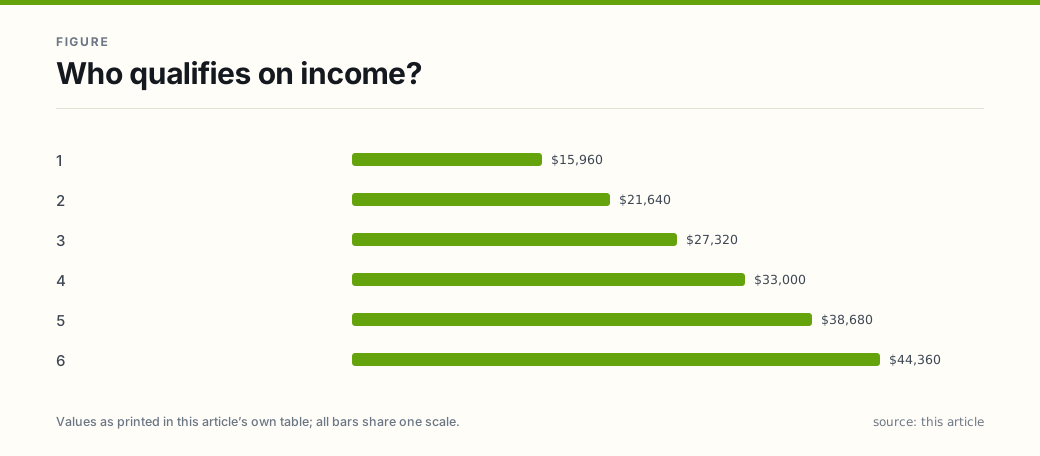
The test is household income at or below the poverty line, using the guidelines HHS publishes each year. These are the 2026 figures for the 48 contiguous states and the District of Columbia:
| People in household | 2026 poverty guideline |
|---|---|
| 1 | $15,960 |
| 2 | $21,640 |
| 3 | $27,320 |
| 4 | $33,000 |
| 5 | $38,680 |
| 6 | $44,360 |
Add $5,680 for each person beyond six. Alaska and Hawaii publish separate, higher figures: $41,250 for a family of four in Alaska and $37,950 in Hawaii. A family of four in Anchorage earning $38,000 is under the Alaska line and over the figure used in Ohio; where you live changes which table applies.
Which families qualify regardless of income?
Three routes bypass the income test. A pregnant woman or child is eligible if the family is eligible for public assistance, “or, in the absence of child care, would be potentially eligible” for it — language that includes TANF child-only payments. The child is also eligible if they are homeless or in foster care. The Office of Head Start’s own application page names TANF, SSI and SNAP as the public-assistance routes it recognizes.
“Potentially eligible” is a wider door than “currently receiving”, and it is the one most families miss. If you would qualify for SNAP or TANF but never applied, say so at intake; a program can accept documentation from the state or local agency showing you are potentially eligible.
What if you earn slightly more than the poverty line?
Two allowances exist, and both are the program’s choice rather than your right.
The first lets a program enroll children who would benefit from services but do not meet an income test, up to 10 percent of its enrollment. The second sits on top of the 10 percent: a program may enroll an additional 35 percent of participants whose families are below 130 percent of the poverty line — for a family of four, $42,900 in 2026 — if it has outreach and enrollment policies that first serve eligible pregnant women, children and children with disabilities, and criteria that keep those families ahead of over-income ones. A program using that allowance must also be able to report to its regional office on how it is meeting the needs of the eligible families in its area.
In practice this means a family at 115 percent of the poverty line is not automatically out. Ask the program whether it uses either allowance, and how full it is.
How do you apply?
The process is local, and it starts with finding the agency that holds the grant.
- Find a program. Use the Office of Head Start’s center locator, which maps programs by address and type — Head Start Preschool, Early Head Start, Migrant and Seasonal, American Indian and Alaska Native. If you would rather talk to someone, the national line is 1-866-763-6481, Monday to Friday, 12pm to 6pm ET.
- Call the program you found. The locator lists a phone number for each center. Ask whether it has an open slot, what its intake process is, and what documents it wants.
- Interview. Program staff interview each family — in person, or by telephone when an in-person visit is not possible or convenient.
- Verify income. Tax forms, pay stubs or other proof of income for the relevant period; a written statement from an employer if you are self-employed; a signed declaration if you have no income, along with a description of what the program did to check it.
- Ask about the housing adjustment. A program may reduce the income it counts if you spend more than 30 percent of your gross income on housing, using bills or bank statements. This is discretionary, and it can move a family from just over the line to just under it.
- Apply to a second program if the first is full. Waiting lists are per program, not per state.
What documents should you bring?
Programs ask for proof of income and proof of the child’s age, and they may ask for proof of address or of the qualifying circumstance — a foster placement letter, a homeless-services statement, an award letter for SNAP or TANF. Two rules protect you here: a program cannot require age documents in a form that creates a barrier to enrolling the child, and if you cannot produce standard income paperwork, a written employer statement or a signed no-income declaration is acceptable with verification.
Bring what you have and say what you do not have. Intake staff have some discretion about documents; they have none about the eligibility tests themselves.
What happens if the program is full?
Ask for the waiting list, and ask where your child sits on it. The regulation requires programs to set selection criteria each year that weigh income, homelessness, foster care, the child’s age, and whether the child is eligible for special education or early intervention services, and to keep a waiting list ranked according to those criteria — so a family in a priority category can move up, and a family that is simply early in the queue may not.
If the nearest program is full, the practical alternatives are a second Head Start agency within driving distance, Early Head Start if the child is under three, a state- or district-funded pre-K program, and the child care subsidy your state runs under the federal Child Care and Development Fund. Those programs have different rules and different waiting lists; none of them is a substitute for Head Start’s service model, and a child can be enrolled in Head Start and another program at the same time if the schedules fit.
Does it cost anything?
Head Start does not charge tuition. The federal grant pays for the core services, and the Office of Head Start describes them as free to families. Costs that can still appear are indirect: transport if the program does not run a bus, extended-day care if you need hours beyond the program’s day, and supplies a particular center asks for. Ask about each before you enroll rather than after.
What is the bottom line?
Head Start is free and open to children from birth to 5 whose family income is at or below the federal poverty line — $33,000 for a family of four in 2026 — or whose family receives or could receive public assistance, is homeless, or has a child in foster care. The application is made to a local grant recipient, not to Washington, and a family just above the line should still ask, because programs may fill part of their enrollment with children who do not meet the income test.
If your child has a disability, the rules that apply are different in one important way: a program cannot refuse enrollment because of a disability at all, and at least 10 percent of its enrolled children must be children with disabilities. We explain how that works, and how to request an evaluation, in Head Start and children with disabilities.
Frequently asked questions
- Is Head Start free?
- Yes. Head Start is federally funded and does not charge families tuition for the early learning, health, nutrition and family services it provides; the Office of Head Start describes the services as free. What sits outside the core program — transport, extended hours, diapers — differs from one grant recipient to the next, so ask the program you are applying to rather than assuming.
- Do you have to be on welfare to qualify for Head Start?
- No. Most families qualify on income: at or below the federal poverty line, which for a family of four in the 48 contiguous states and Washington, D.C. is $33,000 for 2026. Receiving or being eligible for public assistance such as TANF, SSI or SNAP is an alternative route that qualifies a family regardless of income, as are homelessness and foster care.
- What if our income is slightly above the poverty line?
- Ask anyway. The regulation lets a program fill up to 10 percent of its enrollment with children who would benefit but do not meet an income test, and it allows a larger share — up to 35 percent — for families below 130 percent of the poverty line, provided the program first does outreach to eligible families and can report on it. Those are options a program may use, not an entitlement, and they are the first places a waiting list moves.
- Is there a deadline to apply for Head Start?
- There is no national application deadline and no federal application form: you apply to a local grant recipient, and each one runs its own intake. Enrollment depends on whether that program has an open slot, so the practical deadline is whenever its slots fill. If it is full, ask to be put on the waiting list and apply to a second program nearby.
- Can a Head Start program refuse a child with a disability?
- No. The performance standards say a program must not deny enrollment based on a disability or chronic health condition, or on its severity, and enrolled children with disabilities must receive all applicable services in the least restrictive possible environment. Federal law also requires that at least 10 percent of the children a program actually enrolls be children with disabilities eligible under the Individuals with Disabilities Education Act.
Sources
Each source is a primary or official reference, checked before publication. Links open the original.
- U.S. Department of Health and Human Services, Administration for Children and Families, Office of Head Start — final rule 'Restoring Flexibility To Support Head Start Program Access', Doc. No. 2026-23279, published November 16, 2026 (program description: children prenatal to age 5 from low-income families, center- and home-based settings, founded 1965, the service categories the performance standards require) — https://www.federalregister.gov/d/2026-23279
- 45 CFR 1302.12, Determining, verifying, and documenting eligibility (income at or below the poverty line; public assistance, homelessness and foster care as alternative routes; the 10 percent and 35 percent over-income allowances; the interview; age verification; acceptable income documents; the housing-cost adjustment above 30 percent of gross income) — https://www.ecfr.gov/current/title-45/section-1302.12
- 45 CFR 1302.14, Selection process (the factors a program must weigh, including income, homelessness, foster care and eligibility for services under IDEA; the prohibition on denying enrollment because of a disability or chronic health condition) — https://www.ecfr.gov/current/title-45/section-1302.14
- U.S. Department of Health and Human Services, Office of the Assistant Secretary for Planning and Evaluation — 2026 Poverty Guidelines (48 contiguous states and D.C.: $15,960 for one person, $33,000 for four; $5,680 for each additional person; separate figures for Alaska and Hawaii) — https://aspe.hhs.gov/topics/poverty-economic-mobility/poverty-guidelines
- Office of Head Start — 'How to Apply' (income at or below the poverty level; TANF, SSI or SNAP, foster care and homelessness qualify regardless of income; free services from birth to 5; the center locator; the national line 1-866-763-6481, Monday to Friday, 12pm–6pm ET; page last updated February 13, 2026). The page sits behind a bot filter that blocks automated requests, so it was read through a rendering proxy and its existence cross-checked from the Office of Head Start index page — https://headstart.gov/how-apply
- Office of Head Start, Administration for Children and Families (program index, linking to the application guide and the center locator) — https://www.acf.hhs.gov/ohs